
I recently received an email from someone I’ve known for quite a few years now. We’ve sparred theologically over that time, and I think it’s fair to say that we share a mutual respect.
He asked me, “What good does it do to publicly complain online? How is the mystical body of Christ built up by internet venting?”
And it’s a fair question. There is a real danger that comes when one crosses the line from alerting people to danger to delighting in scandal. This danger is intensified when it seems that only the tiniest minority of people see what you believe to be manifestly true. You wish to exonerate yourself. You want to provide examples. Every time you read a news story that confirms what you believe, you want to publish it and point to it and tell the world, “SEE??! I’VE BEEN TRYING TO TELL YOU!”
Yes, it’s a dangerous game. But it’s one that must be played.
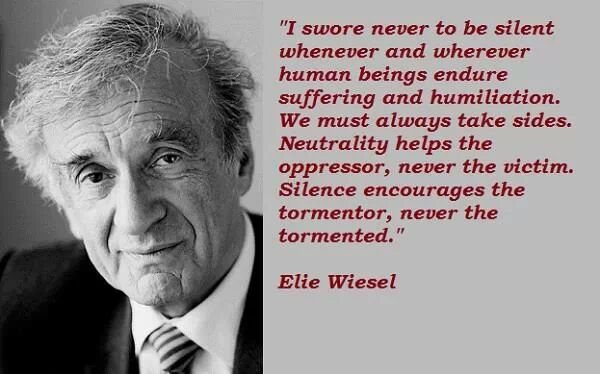
We live in a very public world. People with power have always been attempted to abuse that power. The only thing we can do to combat the abuse of power is to change the way the game is played. Power-abusers hide from the light. When I saw this quote yesterday from Elie Wiesel, it struck me as tremendously appropriate for our times:

I remember clearly the way the Legionaries of Christ would try to turn my own friends against me, or would warn their prospective recruits not to talk to me, because I had no qualms about revealing the abuses of power, the manipulation, the deceit, the corruption that I saw rampant in that organization — and this long before the depth of Maciel’s depravity was revealed.
I am reminded of that when I see the gag order filed against the parents of Justina Pelletier, forbidding them from speaking out about the medical abduction of their daughter by Boston Children’s Hospital. And when her father finally defied the order and went to the press, the power structure holding them hostage began to crumble.
There are a number of recent examples that one could call to mind on the geopolitical and ecclesiastical stage. The important thing is that we have reached a point of asymmetry in the historical distribution of power. The Internet is 25 years old this week. And it has changed…everything. People, no matter how small, have a voice. A voice that can be amplified exponentially when others catch wind of the truth.
The Catholic Church is no less subject to these new forces. There was a time, not long after the Second Vatican Council, when the bishops who wanted to suppress the Church’s ancient liturgy or desecrate her traditions could do so with impunity.
That time is over. This is an age of accountability. When something sacred is treated as disposable, when communities of believers are punished with forced allegiance to Modernist changes they have legitimately and prudently chosen to avoid, that’s a place where the light should shine.
I don’t know about you, but I want my Catholicism back. I want a Church I can be proud of, a Church that remembers what it believes in. A Church that doesn’t scandalize so deeply that it damages or even destroys the faith of its own members and makes no effort to appeal to those outside her bosom except when creating the false appearance that non-negotiable things have become negotiable.
If this isn’t the foretold time of apostasy, it must be the precursor. Pope St. Pius X warned us, with great urgency:
“[T]hey put into operation their designs for Her [the Church’s] undoing, not from without but from within. Hence, the danger is present almost in the very veins and heart of the Church, whose injury is the more certain from the very fact that their knowledge of Her is more intimate. Moreover, they lay the ax not to the branches and shoots, but to the very root, that is, to the faith and its deepest fibers.”
Fight back. Please. Don’t let the virtue of docility you have cultivated out of a love of God and His shepherds make your voice falter. If you care about your faith, stand up for it – not just against enemies outside the Church, but against those within. As Pope John Paul II always reminded us, “Do not be afraid.”
For some, this fight will come through contemplative prayer. For others, the living of their vocation in their homes, their parishes, or in the world. For those who can, for those with a voice, we should cry out. (For many of us, it should be some combination of the three.)
I am not advocating rash thought or careless speech, and I am certainly guilty of both at times. I am often angry when confronted with the “Devastated Vineyard”. I often fail to show charity when it is most needed. I will confess it to anyone: I am a wretched sinner. I don’t say this to burnish my rough edges with a facade of humility. I say it because I am so deeply aware that it is true, as are the poor priests who hear my confessions.
It’s not my place to judge souls, but I do feel an obligation to judge words and actions. Especially public words and actions. The Roman Catholic Church is perhaps the most scholarly institution in the history of the world. Everything she believes is written down for us to read and understand. There is no mystery concerning what she teaches. It only becomes confusing if one avoids this knowledge and listens only to those who are in ecclesiastical authority today. We are fortunate, however. If we are not the most literate generation of Catholics in the history of the world, we are very close. And because of technology, we have access to so much more of the Church’s wisdom and thought than anyone who came before us. We have the criteria to make comparisons. We have the tools to prudently discern.
We do not have the authority to make real, formal accusations of heresy. That is for the hierarchy alone — and we should pray that God will send us prelates who will speak the truth. But what we can do is point out the contradictions. As Chesterton said, “The only sin is to call green grass gray.”
The Church’s guarantee of indefectibility is not a guarantee of general orthodoxy. It is not a guarantee that most of the Church will not fall into heresy and decay. It is a guarantee of survival, by whatever margin Our Lord wills. In this respect, I can’t help thinking of Abraham pleading for Sodom: “Oh may the Lord not be angry, and I shall speak only this once; suppose ten are found there?” Is that enough? How many faithful are required for the Church to remain standing at the time of judgment?
There’s too much at stake. I won’t take it quietly. I can’t.
Will you?
I wonder why Elie Wiesel doesn’t speak up and denounce the oppression of the Palestinian people then?
Aaaaannnd first comment derails the discussion entirely before it even starts. Well played.
This is dead on. The molestation of our sons (mostly) would be still going on if everybody had just quietly tolerated it: and that is just the most extreme example.
Fr. Owen Francis Dudley was the head of an British evangelization society between WW I and WW II, and he also wrote books. From You and Thousands Like You (1949), Chapter 9:
“When you see a Church that refuses all compromise, all soft sayings in the place of hard truths; when you see a Church that refuses to pander–know then that you see the Church of Christ.”
A character says this in The Shadow on the Earth (1926), Chapter XI:
“I’ve come bang up against the Catholic religion here–I’ve been watching it, and reading about it–and it’s an utterly different kind of thing. It’s real. It’s got authority; it’s perfectly certain of itself. It knows. It’s not afraid of the world; it doesn’t climb down and pander to you–it doesn’t lick your boots. It challenges you; dares you to deny! It’s a terrific thing! …And these Catholics love it–passionately; I’ve seen them at it. It’s what Christianity would be. It’s what those martyrs died for, I’m certain…”
By way of contrast: Will Men be like Gods? (1924), Chapter IX, Soft Sayings and Hard Facts:
“[Humanitarians/modernists] purr forth soft sayings, for the liking of a soft generation. Stern facts are not for such as these. Truth comes, not softly clothed, but clad in mail. Those who would win her must face facts fearlessly.”
As to your article, the obvious objection is that the Church is not a political organization: but it does not follow from that that there are no human characteristics that are present in both. Moreover, those who are driving the hardest towards the route pioneered by the mainline Protestant churches certainly seem to regard the Church as primarily political.
Wow, those are some fantastic quotes. Are any of those available as ebooks?
As for the Church? She is the oldest continually operating political organization on earth. And I would be not be shocked to find out that less than half the Catholic prelates in this world even believe in God. (The pope says there is no “Catholic God”, so…what is there?) It’s a power game for many. And an agenda position for most.
The books are available free on archive.org
His novels in print are all available in hard cover here for $35: https://id34104.securedata.net/libers.com/merchantmanager/product_info.php?products_id=31
They are not available as ebooks. They may be out of copyright by now, but if so I’m not aware of them being available anywhere for free.
It was surprised to hear that series of books mentioned. I have a set and enjoyed them too. Perhaps not on a par with Father Hugh Benson fiction, but adequate. FULL OF GREAT QUOTES in defense of the FAITH. Wouldn’t it be welcome if the Pope quoted them.
Bravo! Bravo! This deserves a long round of applause, even if it is from your friends in the echo chamber.
It’s a nice echo chamber. Comfy chairs. Lots of bourbon.
Agreed. :o)
yeah. Catholics need to speak up, especially on the internet. And when they falter, as they inevitably will, other Catholics have a responsibility to be more forgiving and not all up in their grills about it. There is no such thing as polite warfare, spiritual or otherwise.
Great Article Steve!
FYI
A great link. http://www.papalencyclicals.net/
I assure you that, despite an obvious shift in emphasis at my blog of late, I am not done fighting for the truth (Sirach 4: ). I am just taking a deeper, more elliptical route towards putting the Spin-and-Noise Machine in its proper place. To defeat against a slugger, one must bob and weave. Indeed, what better time to sharpen our tools than Lent? As Benedict XIV wrote in–note well the title–Non Ambigimus:
“The observance of Lent is the very badge of the Christian warfare. By it we prove ourselves not to be enemies of the cross of Christ. By it we avert the scourges of divine justice. By it we gain strength against the princes of darkness, for it shields us with heavenly help. Should mankind grow remiss in their observance of Lent, it would be a detriment to God’s glory, a disgrace to the Catholic religion, and a danger to Christian souls. Neither can it be doubted that such negligence would become the source of misery to the world, of public calamity, and private woe.”
Permit me also to quote at length from Leo XIII’s Sapientiae Christianae:
“12. …[I]n many countries Catholicism is either openly assailed or else secretly interfered with, full impunity being granted to the most pernicious doctrines, while the public profession of Christian truth is shackled oftentimes with manifold constraints.
“13. Under such evil circumstances therefore, each one is bound in conscience to watch over himself, taking all means possible to preserve the faith inviolate in the depths of his soul, avoiding all risks, and arming himself on all occasions, especially against the various specious sophisms rife among non-believers. In order to safeguard this virtue of faith in its integrity, We declare it to be very profitable and consistent with the requirements of the time, that each one, according to the measure of his capacity and intelligence, should make a deep study of Christian doctrine, and imbue his mind with as perfect a knowledge as may be of those matters that are interwoven with religion and lie within the range of reason. And as it is necessary that faith should not only abide untarnished in the soul, but should grow with ever painstaking increase, the suppliant and humble entreaty of the apostles ought constantly to be addressed to God: “Increase our faith.”(11)
“14. But in this same matter, touching Christian faith, there are other duties whose exact and religious observance, necessary at all times in the interests of eternal salvation, become more especially so in these our days. Amid such reckless and widespread folly of opinion, it is, as We have said, the office of the Church to undertake the defense of truth and uproot errors from the mind, and this charge has to be at all times sacredly observed by her, seeing that the honor of God and the salvation of men are confided to her keeping. But, when necessity compels, not those only who are invested with power of rule are bound to safeguard the integrity of faith, but, as St. Thomas maintains: “Each one is under obligation to show forth his faith, either to instruct and encourage others of the faithful, or to repel the attacks of unbelievers.”(12) To recoil before an enemy, or to keep silence when from all sides such clamors are raised against truth, is the part of a man either devoid of character or who entertains doubt as to the truth of what he professes to believe. In both cases such mode of behaving is base and is insulting to God, and both are incompatible with the salvation of mankind. This kind of conduct is profitable only to the enemies of the faith, for nothing emboldens the wicked so greatly as the lack of courage on the part of the good. Moreover, want of vigor on the part of Christians is so much the more blameworthy, as not seldom little would be needed on their part to bring to naught false charges and refute erroneous opinions, and by always exerting themselves more strenuously they might reckon upon being successful. After all, no one can be prevented from putting forth that strength of soul which is the characteristic of true Christians, and very frequently by such display of courage our enemies lose heart and their designs are thwarted. Christians are, moreover, born for combat, whereof the greater the vehemence, the more assured, God aiding, the triumph: “Have confidence; I have overcome the world.”(13) Nor is there any ground for alleging that Jesus Christ, the Guardian and Champion of the Church, needs not in any manner the help of men. Power certainly is not wanting to Him, but in His loving kindness He would assign to us a share in obtaining and applying the fruits of salvation procured through His grace.
“15. The chief elements of this duty consist in professing openly and unflinchingly the Catholic doctrine, and in propagating it to the utmost of our power. For, as is often said, with the greatest truth, there is nothing so hurtful to Christian wisdom as that it should not be known, since it possesses, when loyally received, inherent power to drive away error.
Oops, I meant to note Sirach 4:23-28 —
“Do not refrain from speaking at the crucial time, and do not hide your wisdom. For wisdom is known through speech, and education through the words of the tongue. Never speak against the truth, but be mindful of your ignorance. Do not be ashamed to confess your sins, and do not try to stop the current of a river. Do not subject yourself to a foolish fellow, nor show partiality to a ruler. Strive even to death for the truth and the Lord God will fight for you.”
archive.org is an amazing resource…
https://archive.org/details/shadowontheearth009132mbp
A wonderful post. Thank you. Here’s a couple quotes that helped me during a very difficult time in a former parish:
“History will have to record that the greatest tragedy of this period of social transition was not the strident clamor of the bad people, but the appalling silence of the good people.” — Dr. Martin Luther King, Jr.
And this:
“In keeping silent about evil, in burying it so deep within us that no sign of it appears on the surface, we are implanting it, and it will rise up a thousand fold in the future. When we neither punish nor reproach evildoers, we are not simply protecting their trivial old age, we are thereby ripping the foundations of justice from beneath new generations.” — Aleksandr Solzhenitsyn
http://www.ccel.org/ccel/schaff/npnf212.iii.iv.iii.iv.html
The Pope is the problem, not the powerless lay man. He refuses to do his duty.
Keep up the great work, Mr Skojec