
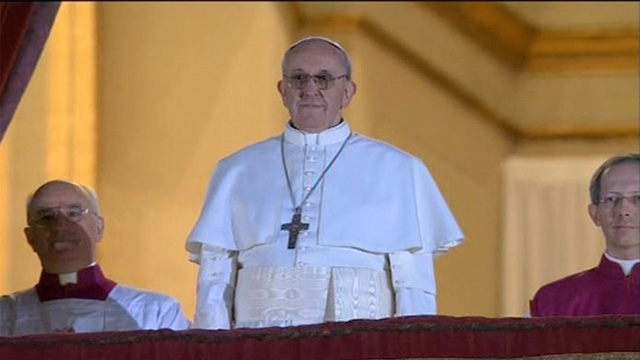

I’ve written about mine before, and I haven’t heard the end of it.
Boniface at the blog Unam Sanctam Catholicam asks the question of his readers, sharing his own first impression:
Then Jorge Bergoglio stepped out onto the loggia. Overwhelmed by the applause and the intensity of the moment, he just stared off the balcony with a thin, weak smile, sweat visibly rolling down his cheeks. He awkwardly waved and continued to stare as the commentators attempted to do some hasty research and explain who Jorge Bergoglio was.
I consider myself a Catholic who is fairly well educated about the Church at large, but I had no idea who Bergoglio was. I had never heard of him and certainly did not recognize his face. He was a nobody to me. A complete blank slate. I had no opinions about the man for good or for ill.
Yet, strangely, when I first saw the new pope, a terrible, ominous feeling came over me. A feeling of…well, not dread, but a deep, heavy and oppressing sense of trouble – foreboding. In fact, my stomach kind of sank and I felt sick. This reaction was a mystery to me then and continues to be so now; I was a college student in 2005 when Ratzinger was elected, and when Ratzinger walked out onto the loggia, I was filled with jubilation and joy – even a supernatural sense of filial devotion and piety which I noticed fill my heart when Benedict XVI was introduced. And at that time I knew very little about Ratzinger, either.
Such a contrast between the two conclaves! I was again expecting 2013 to be a conclave of joy, like 2005 – but I was very disoriented and troubled when Pope Francis was announced. Everything just seemed…under shadow.
I thought this was just my own private reaction, but over the past year I have heard countless stories of people sharing the same anecdotes. Common phrases to describe that moment are “ominous”, “foreboding”, “sinking feeling in my stomach”, “sick” and so on. I have been honestly shocked at how many people I have run across who explained feeling a similar sensation on the eve of the Holy Father’s election. It seems to be something of a phenomenon.
I know feelings don’t necessarily mean anything, and I do not want to read more into this than what there is. But I am now curious, did you have a similar experience? How widespread was this premonition of foreboding among traditional Catholics?
Since he’ll probably be attacked by the usual suspects, I encourage you to leave him a comment with your own impressions. Let’s make it clear that he’s not alone. There’s something to the dread that many people felt upon the pope’s first appearance on the loggia, of that I’m certain. Too many of us were surprised by the reaction for it to have been some pre-determined bias against a man we’d never heard of or even seen a picture of.
Unnerved, with a strong sense that something was off, and I couldn’t put my finger on what.
(This may have been the signal grace you felt. This was the last deathbed vision from the most famous FRANCIS of all time. Wonder why THE MOST HIGH would have the most famous FRANCIS of all time have such a disturbing, nefarious vision immediately before taking Lucifer’s spot in Heaven? Hmm?)
Shortly before he died, St. Francis of Assisi called together his followers and warned them of the coming troubles, saying:
“1. The time is fast approaching in which there will be great trials and afflictions; perplexities and dissensions, both spiritual and temporal, will abound; the charity of many will grow cold, and the malice of the wicked will increase.
“2. The devils will have unusual power, the immaculate purity of our Order, and of others, will be so much obscured that there will be very few Christians who will obey the true Sovereign Pontiff and the Roman Church with loyal hearts and perfect charity. At the time of this tribulation a man, not canonically elected, will be raised to the Pontificate, who, by his cunning, will endeavour to draw many into error and death.
“3. Then scandals will be multiplied, our Order will be divided, and many others will be entirely destroyed, because they will consent to error instead of opposing it.
“4. There will be such diversity of opinions and schisms among the people, the religious and the clergy, that, except those days were shortened, according to the words of the Gospel, even the elect would be led into error, were they not specially guided, amid such great confusion, by the immense mercy of God.
“5. Then our Rule and manner of life will be violently opposed by some, and terrible trials will come upon us. Those who are found faithful will receive the crown of life; but woe to those who, trusting solely in their Order, shall fall into tepidity, for they will not be able to support the temptations permitted for the proving of the elect.
“6. Those who preserve their fervour and adhere to virtue with love and zeal for the truth, will suffer injuries and, persecutions as rebels and schismatics; for their persecutors, urged on by the evil spirits, will say they are rendering a great service to God by destroying such pestilent men from the face of the earth. but the Lord will be the refuge of the afflicted, and will save all who trust in Him. And in order to be like their Head, [Christ] these, the elect, will act with confidence, and by their death will purchase for themselves eternal life; choosing to obey God rather than man, they will fear nothing, and they will prefer to perish rather than consent to falsehood and perfidy.
“7. Some preachers will keep silence about the truth, and others will trample it under foot and deny it. Sanctity of life will be held in derision even by those who outwardly profess it, for in those days Jesus Christ will send them not a true Pastor, but a destroyer.”
(Except for breaking up the narrative into numbered paragraphs and adding bold print for emphasis, the prophecy is presented without any alteration, as given in the Works of the Seraphic Father St. Francis Of Assisi, Washbourne, 1882, pp. 248-250;)
I think I’ve come across these before, but after the past couple weeks, these hit me hard this time. Wow.
You aren’t kidding. Among so many other things, it’s impossible not to see the Franciscans of the Immaculate debacle in all this.
Wow, those were my sentiments exactly. When Ratzinger was elected, I was still about 5 months away from entering the Church, and although I knew almost nothing about him, I was nevertheless thrilled. But not so with Bergoglio. I too had that sick sinking feeling in my stomach, wondering, “Who is this guy, and what’s wrong with him?” But unlike Boniface, for some time now, I’ve understood why.
For me the tipping point came when a certain atheist quipped that he wondered if Francis might want to convert him, only to be told by that same Francis that such things are “solemn nonsense.” I still can’t make any sense out of that; it simply doesn’t compute. In fact, I can’t think of a more un-Catholic thing to say; converting the lost is the primary reason we exist; take that away, and there’s nothing left.
I got the creeps. And my reaction, in all honesty, was “man of perdition”. I do not say he is that, or that I have not tried to squelch my own negative reaction. I just say gat was the inner word I felt when he stepped out onto that balcony and surveyed the scene. He looked like one who calmly assessed the crowd he would rule.
Like I said, I do not say that is what he is. But that was, honestly, my strong and immediate reaction. I felt strongly gist we were in trouble.
“He looked like one who calmly assessed the crowd he would rule.”
Yes. Or eat them. It’s hard to say how you can see so much in a blank face, but there was something disturbingly triumphant in it.
Excuse my autocorrected spelling above.
gaze
I’m glad you brought this up again because I too had a similar experience. I was at work and praying very hard that Cardinal Raymond Burke or someone of his character would, by God’s grace, be elected. My boss came in and turned on the television and we waited for the announcement. As he walked out my first impression was who is this man, I’ve never heard of him before. Then as I watched him suddenly I felt a chill run up my spine with the thought that something is very wrong here! Also, for a moment, it appeared that his body became very rigid and I felt such coldness from him that it made me take a step back. Today I believe that he was made Pope by those who want a “New World Order” to bring down the Church in the same way that Obama is bringing down the USA.
Curious if you’ve ever read the synopsis of Windswept House:
“Windswept House describes a satanic ritual – the enthronement of Lucifer – taking place at Saint-Paul’s Chapel inside Vatican City, on June 29, 1963. The book gives a scary depiction of high ranking churchmen, cardinals, archbishops and prelates of the Roman curia, taking oaths signed with their own blood, plotting to destroy the Church from within. It tells the story of an international organized attempt by these Vatican insiders and secular internationalists to force a pope of the Catholic Church to abdicate, so that a successor may be chosen that will fundamentally change orthodox faith and establish a New World Order.”
Have you ever read “The Jesuits”? You want the final piece to the puzzle, get a copy and read it this summer.
Steve, may God forgive me if I’m wrong, but I can’t shake the feeling that Francis and Obama are playing for the same team. And yes, I read this book many years ago, so it appears that Malachi Martin was absolutely prophetic. What times we live in!
From: wewjude
Sent: Wednesday, March 13, 2013 11:12 PM
To:
Subject: Letter #46: Pope Francis
Weird/bizarre/troubling first impression. I can’t deny what I felt in my soul though….I hope/pray that I’m just misreading..however:
Not one mention of Jesus Christ!
Not one sign of the cross blessing with the hands!
No uplifting words of hope for the soul….I’m sorry, I think he came across as exceptionally stiff/scared/cold???
I hope the wolves haven’t won….perhaps we now know what that great sign of lightening hitting St. Peter’s was portending!
God bless and long live our suffering Pope (Emeritus?) Benedict XVI!
wewjude
I was simply numb, and felt crestfallen. For me the hardest thing has been an inability to pray for Francis as Pope ever since. It might be scrupulosity on my part, but my intellect and my heart just can’t be convinced he is Pope.
I remember exactly where I was and who I was with when Ratzinger was elected, and the sense of jubilation at the time, which in hindsight I feel was well deserved.
Not this time.
I am a devotee, as many are, of the DIVINE MERCY. In Saint Faustina’s diary, Our Lord asks her to pray 33 Blood and Water prayers for The Holy Father’s intentions. I had done so for 20 years, but I stopped with Bergoglio. There are several back-stories, speculations, etc..as to why Benedict quit. In January of that year, the false mystics of Medjugorge were in Rome openly saying they would divulge secrets about Benedict, if, as expected, he forbid, under penalty of sin, any cooperation with this billion-dollar/occult fraud. I suppose I was hoping that Benedict could force the hand of God and Peter Romanus would be given us, the last great Roman Pontiff. It’s curious that Benedict’s “Hitler Youth” past is continually trumpeted, but the following is not..http://shar.es/Pviuu
Buenos Aires – As Pope Francis takes his place as the leader of the world’s 1.2 billion Catholics, his participation in Argentina’s US-backed ‘Dirty War’ is sure to come under increased scrutiny.
From 1976 until 1983, Argentina was governed by a series of US-backed military dictators who ruled with iron fists and crushed the regime’s opponents, many of them students, trade unionists, journalists and leftists. Kidnapping, torture, murder by death squads and disappearances characterized this brutal ‘Dirty War,’ and many of the leading perpetrators, including two junta leaders and the military dictator Gen. Leopoldo Galtieri, were trained by the United States in kidnapping, torture, assassination and democracy suppression at the School of the Americas in Panama. As many as 30,000 people were killed or disappeared during this horrific period, and many children and babies were stolen from parents imprisoned in concentration camps or murdered by the regime.
During this harrowing period, the Argentine Catholic church was shamefully silent in the face of horrific atrocities. Argentine priests offered communion and support to the perpetrators of these crimes, even after the execution of two bishops, including Enrique Angelelli, and numerous priests. Worse, leading church figures were complicit in the regime’s abuses. One priest, Father Christian von Wernich, was a former police chaplain later sentenced to life in prison for involvement in seven murders, 42 kidnappings and 31 cases of torture during the ‘Dirty War.’ At his trial, witnesses testified how the priest used his position to gain their trust before passing information to police, who tortured victims– sometimes in von Wernich’s presence– and sometimes killed them.
Senior military commanders who justified the regime’s appalling practice of dumping drugged and tortured ‘Dirty War’ prisoners into the sea from airplanes, known as ‘death flights,’ told participants that the Church sanctioned the missions as “a Christian form of death.”
“We have much to be sorry for,” Father Ruben Captianio told the New York Times in 2007. “The attitude of the Church was scandalously close to the dictatorship to such an extent that I would say it was of a sinful degree.”
So exactly what role did Jorge Bergoglio play in his country’s brutal seven-year military dictatorship?
A 1995 lawsuit filed by a human rights lawyer alleges that Bergoglio, who was leading the local Jesuit community by the time the military junta seized power in 1976, was involved in the kidnapping of two of his fellow Jesuit priests, Orlando Yorio and Francisco Jalics, who were tortured by navy personnel before being dumped in a field, drugged and semi-naked, five months later.
At the time, Bergoglio was the superior in the Society of Jesus of Argentina. According to El Silencio (Silence), a book by Horacio Verbitsky, one of Argentina’s most respected investigative journalists, Bergoglio urged the two priests, who were strong believers in liberation theology, to stop visiting Buenos Aires slums where they worked to improve the lives of some of the country’s poorest people. After the priests refused, Bergoglio allegedly stopped protecting them, leading to their arrest and torture. According to the Associated Press, Yorio accused Bergoglio of “effectively handing [the priests] over to death squads.”
Despite his alleged role in the Jesuits’ imprisonment, Bergoglio did eventually take action to secure their release. His intervention and appeal to the vicious junta leader Jorge Videla quite likely saved their lives.
But that wasn’t the only time Bergoglio allegedly cooperated with the regime. According to Verbitsky, he also hid political prisoners from a delegation of visiting international monitors from the Inter-American Human Rights Commission.
Bergoglio was also silent in the wake of Father Angelelli’s assassination, even as other leading Argentine clergy condemned the murder. He was quick, however, to hail the slain priest as a “martyr” years later in more democratic times.
“History condemns him,” Fortunato Mallimacci, a former dean at the University of Buenos Aires, once said of Bergoglio. “It shows him to be opposed to all innovation in the church and above all, during the dictatorship, it shows he was very cozy with the dictatorship.”
Human rights attorney Myriam Bregman told the AP that “the dictatorship could not have operated [so brutally] without this key support.”
Bergoglio is also a proven liar when it comes to his personal knowledge of the regime’s atrocities. In 1977, the De le Cuadra family, which lost five members, including a pregnant woman, to state security forces, appealed to the Jesuit leadership in Rome for desperately-needed protection. According to the Associated Press, the Jesuits in turn urged Bergoglio to help the family. Bergoglio assigned an underling to the case, who returned with a note from a colonel stating that the slain woman, who like many other ‘Dirty War’ victims was kept alive just long enough so that she could give birth, had her baby given to a family “too important” to remove it from. The colonel’s letter is written proof that Bergoglio knew about the regime’s practice of stealing babies from its victims, yet the archbishop testified in 2010 that he had no knowledge of stolen babies until after the military regime fell.
“Bergoglio has a very cowardly attitude when it comes to something so terrible as the theft of babies,” Estela de la Cuadra, daughter of Grandmothers of the Plaza de Mayo founder Alicia de la Cuadra, told the AP.
Under Bergoglio’s later leadership as Archbishop of Buenos Aires, the church apologized for its abject failure to protect its flock. But he also refused to appear in open court to answer questions about his role in the ‘Dirty War’ oppression– twice, and when he finally did appear in 2010, his answers– some of which, like the denial of knowledge of stolen babies– left many human rights advocates extremely dissatisfied.
“He doesn’t face this reality and it doesn’t bother him,” de la Cuadra said. “The question is how to save his name, save himself. But he can’t keep these allegations from reaching the public. The people know how he is.”
Read more: http://www.digitaljournal.com/article/345612#ixzz345MrYZSH
Sorry, it goes off the rails with: “Buenos Aires – As Pope Francis takes his place as the leader of the world’s 1.2 billion Catholics, his participation in Argentina’s US-backed ‘Dirty War’ is sure to come under increased scrutiny. ”
—
Argentina had and has its own political dynamic and its government was not and is not a creature of the United States. While we are at it, the public diplomacy of the Carter Administration was decidedly frosty to the Argentine military. The man doesn’t know what he’s talking about.
Even a cursory understanding of geo-politics reveals the United States, on more than one occasion, supporting a fascist-right regime over a commie-left one. If memory serves, Argentina was the favorite refuge of more than a few Nazis. For some reason, Hitler’s boys felt safe there. You would think that the leftist media in this country would be a little interested in this story. We know why they’re not. Bergy is their boy. The one they’ve dreamed about forever. If you get your news and views from the corporate propagandists, I pity you. The only think saving us from total 1930’s German jack-boot depravity is the alternate and social media. Normalcy Bias is a horrible thing. Without courageous venues such as this one, we’d be caught in a matrix of controlled opposition, false paradigms, Kantian triangulations, and psy-opp propositions.
“Even a cursory understanding of geo-politics reveals the United States, on more than one occasion, supporting a fascist-right regime over a commie-left one. If memory serves, Argentina was the favorite refuge of more than a few Nazis. For some reason, Hitler’s boys felt safe there.”
1. Define “support”.
2. Various and sundry Nazi officials made their way to South America and hid out there. Helps to have a deficient paper trail and officials with other things on their mind. That would have been during the period immediately after the war. The character of the regimes in the five receiving countries was highly variable. Of course, all that’s perfectly irrelevant to political life in Argentina 30 years later (which was, in addition, in the hands of political factions quite hostile to those in charge from 1946 to 1955).
You’re memory needs improvement.
It appears that the Argentine government also actively supported Nazi Germany during the war, and that the offer of a safe haven to Nazis after the war was simply an extension of this support.
The main villain of this piece, perhaps unsurprisingly, was Juan Perón. Perón was sympathetic to the Nazi cause and in 1943 traveled to Germany to discuss the possibility of an arms deal between Argentina and Germany.
Investigators believe that following the war, a cabal of ex-Nazis and Nazi collaborators formed in Argentina and worked with the Perón government (he became president in 1946) to organize the emigration of hundreds, perhaps even thousands, of their kind to Argentina. Members of the group frequently travelled to Europe to look for and bring back more of the fugitives.
It’s not known exactly how many ex-Nazis were brought to Argentina during the late 1940s and early 1950s. One researcher identified 300, but there easily could have been more. What is known is that they included Josef Mengele, Adolf Eichmann and his adjutant Franz Stangl, Erich Priebke (a former Captain in the Waffen SS), Klaus Barbie – also known as ‘the Butcher of Lyon’ (a former Captain in the SS and a member of the Gestapo), Ustasha Dinko Šakić (former commandant of the concentration camp that was nicknamed ‘the Auschwitz of the Balkans’) and many, many others.
The ex-Nazis were given landing permits and visas and it has also been claimed that many of them were even given jobs in Perón’s government.
In 1998, while opening the Commission for the Clarification of Nazi Activities in Argentina, the Argentine foreign minister Guido di Tella described the collaboration between Argentina and Nazi Germany as a ‘painful and shameful’ episode in Argentina’s history. It is undoubtedly that. However, in fairness it must also be mentioned that as well as accepting ex-Nazis, Argentina under Perón also accepted more Jewish immigrants than any other country in Latin America. Today Argentina has over 200,000 Jewish citizens, the sixth-largest population of Jewish people in the world. While Perón clearly sympathized with Nazi Germany, he also sympathized with the Jews. Also, it seems that a big motivation for Perón in inviting ex-Nazis to Argentina was that he hoped to acquire from them German technology that had been developed during the war. It wasn’t, or wasn’t only, that he wanted to protect the ex-Nazis from the consequences of their crimes.
But what about the present day. Might there be ex-Nazis still alive and living in Argentina today? Could you see one on the street of Buenos Aires? It seems unlikely. After all, someone who was 35 in 1940 would be 105 this year (2010) and probably would have died of natural causes. However, the director of the Simon Wiesenthal Center (which is dedicated to tracking down escaped war criminals) believes that potentially dozens of lower-level Nazi war criminals – who would have been younger than their superiors – might still be alive. The Simon Wiesenthal Center has launched an operation called ‘Operation Last Chance,’ which is a final effort at finding and bringing to trial as many ex-Nazis as possible before they die of old age. Nazis & Argentina: a History Lesson
Posted in History on June 22, 2010
(So one might surmise there is a HISTORY of fascism in that country the people seem to support. A history a certain Jesuit would be aware of. It would be similar to denying the vestiges of slavery/racism in this country.)
And ever hear of Iran-Contra, Mujahadin in Afghanistan, etc..supporting facists to oppose communists (lesser of two evils thinking)? Maybe you should jog your memory.. =+)
Argentina is located in the Southern Cone of South America. They were not in a position to ‘support’ (or oppose) a set of military forces in either the European or Pacific theatre. The country was neutral in the 2d World War until a pro-forma declaration of war in February 1945.
The President of Argentina during most of the war was Ramon Castillo, an unremarkable provincial lawyer active as an electoral politician in the bourgeois / gentry parties. Juan Domingo Peron was the minister of labor from 1943 to 1946. He was President of Argentina after the war, from 1946 to 1955. His government was abusive and hyper-populist but maintained some residual political pluralism; he was an electoral politician, not a Soviet-style party boss. None of the governments which ran Argentina from 1930 to 1955 are properly termed fascist.
In any case, it’s perfectly irrelevant to the situation 30 years later. The Argentine military was in charge of the government from 1976 to 1983 and was an abiding antagonist of the Peronist movement (and by 1976 just about everyone else). Per Jacobo Timmerman, there were blood-curdling characters in positions of influence and ground-level officials had stupefying obsessions, but the regime was on the whole an institutional military government of an unusually severe sort and that’s it. It was not particularly violent after 1979 and left office voluntarily four years later.
None of this has much to do with American provisioning of the insurrection against Soviet rule in Afghanistan (with regard to which the term ‘fascist’ is bizarre).
Considering mohammedism entails a military, political, and religious dynamic, FACISM very much applies. America did the same during the so-called Arab Spring. Catholicism is the only True Faith. The Torah can be understood as a foundational part of the History of God with His People, but the talmud, kabbalah, and koran are the same contributions to religion as the codex gigas. More opposition research than anything else..
No. Every authoritarian system has its own deal. See Stanley Payne on the appropriate use of the term ‘fascism’.
Wouldn’t a pro-Nazi environment also be an anti-Communist one? Consider how the world fought a single dictator while siding with the multi-generational evils of Communism, which were well-identified at the time. How the commie-haters became pro-Liberation Theology socialists might be an interesting story.
The Nazi-sympathizer environment of Argentina may or may not relate to Bergolio today.
I dunno. Just a consideration.
I had no reaction. I was pleasantly interested in the results of the 3 previous conclaves.
I had heard of Bergoglio during the last conclave from my father who had told me Ratzinger was by far a much better choice, though far from the best in his opinion, So when Bergoglio was elected, I also felt a sense of foreboding!
Despite your reservations it is appropriate to pray for him anyway, that whatever his office that he does it to the best of his God-given ability!
I think I had unease, but then being the scrupulously fair guy that I am I wanted to be charitable, and I’m not sure how much I am reading back the now obvious signs into my memory of the event.
People accuse traditionalists of being against the guy from the beginning. That’s not how I remember it. I think Rorate Caeli dutifully published some critical stuff from observers in Argentina (as it should have). But the Remnant, among others, almost seemed cautiously optimistic for the first few months. I think there was hope among some traditionalists that an “outsider” could have a positive effect on the anti-traditionlist aspects of the Vatican bureaucracy. Then came the “proselytization is solemn nonsense” crack and the long train of confusing, embarrassing and just plain un-Catholic and un-Christlike actions and statements from the man. The numerous head fakes-personally “thanking” Gnocchi and the late Mario Palmaro, among other things-helped to prolong the honeymoon, so to speak.
Since traditionalists are supposed to love digging up dirt on non-traditionalists–for the sheer malicious joy of it, I guess, (in those periods when they tire of denying the holocaust and saying the same old prayers over and over again without really meaning them)–it’s amazing to me how little “dirt” was initially unearthed. We actually now know a lot about the man from his days in Buenos Aires, and all of it seems to square with the actions and statements of his Pontificate. Why we didn’t know it then, or why we ignored those who knew it, or at least failed to connect the dots on it then, is a mystery. Or rather, contra the slur that traditionalists are pessimists who WANT things to go badly, we actually wanted and hoped for the best (perhaps ignoring that queasy feeling in our stomachs).
Despite my initial revulsion, I tried to give him the benefit of the doubt:
http://www.catholicvote.org/pope-who-learning-about-the-man-who-is-pope-francis-i/
In hindsight, I realize you can sense my concern, but I strove to make this a balanced piece. I couldn’t hold up for long.
There is something disconcerting about his expression in that photograph.
“Yet, strangely, when I first saw the new pope, a terrible, ominous feeling came over me. A feeling of…well, not dread, but a deep, heavy and oppressing sense of trouble – foreboding. In fact, my stomach kind of sank and I felt sick. This reaction was a mystery to me then and continues to be so now.” I feel like this writer has taken the words right out of my mouth. The words which I am afraid to articulate to others but cannot deny within my heart. This article gave me chills! Lord, forgive me if I am wrong on this one but I feel like something is deeply amiss. We have to pray for this man and for our Church.
It’s interesting that you expressed a sense of Bergoglio as ready to “eat” the crowd. I had the same dire feeling. I’d never heard of him. A day or so earlier, I even said to my husband that no matter who was elected Pope, he’d be a complete stranger to me. I didn’t have any preferred candidate, I just didn’t know any of these guys from a hole in the ground. (And I was still reeling from Benedict’s abandonment of us.)
I’d been watching the TV coverage since the white smoke, and naturally there was a lot of time to fill, so the TV cameras had been showing a lot of closeup shots of the crowd. It was wet and dark, but I noticed how young a lot of the people there were – young families with children, even teenagers. Everyone very cheerful and excited.
Then Bergoglio came out on the balcony, and my stomach dropped. He glared out at that happy, hopeful crowd of sheep, like a general surveying a city he was about to assault and destroy. There was a demonic presence in that scene. I knew he was evil.
“There was a demonic presence in that scene.”
I fear the same.
I also felt weird and a bit intimidated by his blank staring but tried to ignore the feeling. What was quite odd about is speech was his emphasis on Rome and him being the “Bishop of Rome”, as if he was just running some other diocese now.
Well I held off putting my two cents in because I didn’t think I had much to say but I think I’ll stand up and be counted.
I had the vaguest sense of unease but really no more than that. I was caught off guard by the fact that no one seemed to know much about him and I had myself half convinced that it might be Burke (my former Archbishop in St. Louis). Whatever negative feelings I had towards Francis would come later.
Without dismissing anyone’s intuition or experiences, I’ve never cared for the ‘I could see it in his eyes’ kind of commentary. I’ve gone back and watched the video in the highest resolution I could and he looks to me like someone just overwhelmed by the moment and not knowing how to respond. I’ve learned the hard way in my own life and I think it’s largely folly to infer very much from peoples expressions. Besides I knew so many people that expressed the exact same sort of sentiments about Pope Benedict (“You can just see the evil in his eyes!!1!”).
Again, I’m not disputing anyone’s premonitions, just stating that I didn’t share it. With Benedict resigning, I knew that there was almost certainly more to the story than I knew, but I was also afraid (and still am) that there’s more to the story than I may EVER know, like I’m watching some great drama unfold and I have no means to affect the outcome except prayer and I don’t even know what to pray for.
Then look up the Mariavites. They were a sect that came from Poland headed by a nun. Here visions were called The Work of Great Mercy,
http://religion.wikia.com/wiki/Mariavite_Church
Then read ALL 700 pages of Faustina Diary. The whole thing.
Understand that the Mariavites were still very popular in Poland at the time of Faustina’s diary.
JPII loved his country. Polish people (including me) are very nationalistic.
I knew nothing about pope benedict but I too was filled with a profound joy and loved him immediately. He nourished my head and my heart during his papacy. I felt unease about Francis from the start and recoil from his utterances and even pictures of him, in general, give me the creeps.
Weird. I actually felt that way, too. I was there in St. Peter’s Square, right up front, that night. I had the same odd feeling. I had this feeling like somehow the ball had been dropped. I thought that I must feel that way because I liked Pope Benedict XVI so much and didn’t want to lose him. Pope Francis seemed so nervous up there! But that’s not what bothered me. When he bowed and asked for our blessing, I felt that something was really wrong. Why was he asking for our blessing? It was odd. He was doing something out of step with tradition. I worried that he was going to try and be some kind of radical pope who disregards the hermeneutic of continuity.