

I recently had cause to attend a mass celebrated according to the “ordinary form”. I was in the first pew — a rarity for me, since I’m typically wrestling small children in the narthex — and so I had a literal front-row seat to witness the manner in which communion was received by the faithful.
This was not my usual parish, and the priest offering the mass was himself a visitor. I know him very well, however, and he shares most of my opinions on liturgy. He celebrates the traditional mass whenever possible, but as a diocesan priest, he is obligated to celebrate both forms.
As I attempted to pray, I found that I was distracted by the long line of people making their way to the front and, for the most part, thrusting forward their hands to take the precious Body and Blood of Our Lord from the priest’s consecrated fingers.
There was one child who walked about five steps away before shoving the host in his mouth. I followed the worried eyes of the priest as he considered whether or not he would have to confront him. At another moment, I glanced over at some commotion I saw out of the corner of my eye and found the priest talking to a woman who was nodding vigorously, the host still in her hands. I later asked him what happened, and he told me that the host had broken. He had been trying to explain to her that she needed to consume all the particles, because they all contained Christ’s True Presence in its entirety.
“She had no idea what I was talking about.” he said.
In any discussion among well-informed Catholics about the propriety of receiving communion in the hand, one typically encounters the teaching of St. Cyril of Jerusalem on how to do so reverently:
In approaching therefore, come not with your wrists extended, or your fingers spread; but make your left hand a throne for the right, as for that which is to receive a King. And having hollowed your palm, receive the Body of Christ, saying over it, Amen. So then after having carefully hallowed your eyes by the touch of the Holy Body, partake of it; giving heed lest you lose any portion thereof ; for whatever you lose, is evidently a loss to you as it were from one of your own members. For tell me, if any one gave you grains of gold, would you not hold them with all carefulness, being on your guard against losing any of them, and suffering loss? Will you not then much more carefully keep watch, that not a crumb fall from you of what is more precious than gold and precious stones?
If one were to receive on the hand, there seems no better advice than this. And yet, as described above, it is precisely the opposite disposition one most commonly finds in those who approach the Blessed Sacrament with hands outstretched. There is a reason why the Church has long since determined that this method of receiving communion, though common in the early Church, is not advisable: because despite the best intentions of the most pious, as a common practice it leads to sacrilege.
For my part, as I knelt there, watching people literally grab the most sacred substance on earth as if it were a potato chip or a deli ticket, I couldn’t bring myself to look anymore. I had to close my eyes, and I felt them filling with tears. I felt true sorrow for the irreverence shown to the Most Holy Sacrament of the Altar — an irreverence that has become common practice for Catholics around the world.
I was deeply concerned for the priest as well, who under the compulsion of norms founded in abuse and disobedience was forced to participate in something that he knows results in daily desecrations of the Blessed Sacrament. I attempted, however poorly, to make reparation through prayer. I prayed also that the Church would come to its senses and reform its practice — which would really amount only to enforcing its own discipline. I prayed perhaps most fervently that God would strengthen this priest, whom I knew was forced at every mass offered in the “ordinary form” to allow these abuses to continue, despite what his conscience and good sense was telling him. He — and others like him — is given no choice but to acquiesce to something I lacked the fortitude to even look upon.
All of this leads me to question: Where is our sense of the sacred? Why do we not venerate our Eucharistic Lord?
Several years ago, I read a moving anecdote about the innate sense of the Christic presence in the Blessed Sacrament:
Following the papal indult of 1984, Holy Mass was celebrated according to the old rite in a small, unusually hideous chapel on the second floor of a former Kolping house that had been turned into a hotel. It was decorated with dreadful ecclesiastical art: a concrete Madonna in a geometrical style and a crucifix made of red glass that looked like raspberry jelly; these were the sacred objects honored by the incensation. At any rate, no one could have been accused of going to this chapel out of aesthetic snobbery; this cheap slur, so often leveled at those who frequent the old rite, could not be directed at the Frankfurt faithful. The lay people who assembled there did not know very much about how things had to be got ready; they did not know the sacristy customs and only slowly acquired the necessary knowledge. Then a group of women who were in the habit of praying together began looking after the altar linen. I would like to tell you about these women. One day they asked the person in charge of the chapel what happened to the used purificators, that is, the cloths the priest uses to wipe away the remains of the consecrated wine from the chalice. He told them that they were put in the washing machine along with the other things. At the next Mass the women brought a little bag they had made specially, and afterward they asked for the used purificator and put it in the bag. What did they want it for? “Don’t you see? It is impregnated with the Precious Blood: it isn’t right to pour it down the drain.” The women had no idea that in former times the Church did indeed require the priest himself to do the initial washing of the purificator and that afterward the wash water had to be poured into the sacrarium or into the earth; but they just could not allow this little cloth to be treated like ordinary laundry; instinctively they carried out the prescriptions of an ancient rule—albeit one that is no longer observed. One of these women said, “It’s like washing the Baby Jesus’ diapers.” I was a bit taken aback to hear this. I found this folk piety a little too concrete. I observed her washing the purificator at home after praying the Rosary. She carried the wash water into the front garden and poured it in a corner where particularly beautiful flowers grew. In the evening she and another woman prepared the altar. Adjusting the long, narrow linen cloth was not easy. The two women were very intent on their task, and their actions showed a kind of reserved concern, as if, in a sober and efficient manner, they were taking care of someone they loved. I watched these preparations with a growing curiosity. What was going on? All the accounts of the Resurrection mention the folded cloths—“angelicos testes, sudarium et vestes”—as the Easter Sequence says. There was no doubt about it: these women in the hideous, second-floor chapel were the women beside the grave of Jesus. They lived in the constant, undoubted, concretely experienced presence of Jesus. They behaved with complete naturalness in this presence, in accord with their background and education. Their life was adoration, translated into very precise and practical action: liturgy. Observing these women, it was clear to me that they believed in the real presence of Jesus in the Sacrament of the Altar. That shows what faith is: the things we do naturally and as a matter of course.
– Mosebach, Martin. The Heresy Of Formlessness. Ignatius Press.
This is the faith Jesus asks of us! How can we do less than revere this sacred mystery?
[F]or my flesh is true food and my blood is true drink. Those who eat my flesh and drink my blood abide in me, and I in them. Just as the living Father sent me, and I live because of the Father, so whoever eats me will live because of me.
John 6:55-57
As I sat down to write this, what came to mind was the Seefield Eucharistic Miracle, which took place almost seven centuries ago in Tirol, Austria. It is less well known than the Eucharistic miracles of Orvieto and Lanciano, but perhaps more appropriate to the crisis of our time:
On the night of Holy Thursday 1384, a knight named Oswald Milser attended Mass at the parish church in Seefeld. Guardian of a nearby castle, he was a man of great arrogance and pride.
During Mass, the knight approached the high altar with his sword drawn and a band of intimidating armed men, demanding the large host for himself – the small host normally given to the congregation was too ordinary for him.
The frightened priest handed him the host, and Milser remained standing as he took it. But as soon as he had the host in his mouth, the knight sank into the ground up to his knees. Pale with terror, he grasped the altar with both hands, leaving imprints that can still be seen.
The knight begged the priest to remove the host from his mouth. As soon as it was done, the ground became firm beneath him again. The humiliated knight rushed to the monastery of Stams, confessing and repenting his sin of arrogance. The velvet mantle he had worn that night was made into a chasuble and given to the Stams monastery.
In the remaining two years before his death, the knight continued to perform penance for his sacrilege. In accordance with his wishes, he was buried near the entrance of the chapel of the Blessed Sacrament.
Please understand me: it is not my intention to accuse the many millions of Catholics who receive communion on the hand to be guilty of such hubris. Most never give it a second thought, because it is what they were taught to do by the very priests whose job it is to confect and safeguard the Blessed Sacrament.
I, too, was taught to receive communion on the hand. I honestly can’t remember when I came to the realization that this was wrong, only that once I made the switch to receiving on tongue, I could never go back.
Christ nourishes us with His Body and Blood, and we are fed at His own hands, the priest acting as alter Christus as he places the host on our tongues. The Church is our mother, and she, too, nourishes us with her most prized possession, feeding us with her mystical spouse as a mother feeds a child.
Like those charged with the care of the Ark of the Covenant, it is not our place to lay hands on what is sacred. A priest is called by God Himself to touch the Eucharist, to call forth the Divine Presence from heaven in the prayers of Transubstantiation. According to the old rite of ordination:
After the first verse of the hymn the bishop rises and sits on the faldstool (wearing the mitre). He removes his gloves but puts the episcopal ring back on his finger. The gremiale is placed over his knees. The ordained come forward and one by one kneel before the bishop. He then takes the oil of catechumens and anoints both of their hands which they hold together palms upward. First he anoints the inside of the hands, tracing a cross from the thumb of the right hand to the index finger of the left, and from the thumb of the left hand to the index finger of the right. Next he anoints the entire palms. He says as he performs the anointings:
May it please you, O Lord, to consecrate and sanctify these hands by this anointing and our + blessing.
All: Amen.
And having made the sign of the cross over the hands of the ordained he continues:
That whatever they bless may be blessed, and whatever they consecrate may be consecrated in the name of our Lord Jesus Christ.
In the Summa, St. Thomas Aquinas instructs us to remember who should touch the consecrated host, and when:
The dispensing of Christ’s body belongs to the priest for three reasons. First, because, as was said above (Article 1), he consecrates as in the person of Christ. But as Christ consecrated His body at the supper, so also He gave it to others to be partaken of by them. Accordingly, as the consecration of Christ’s body belongs to the priest, so likewise does the dispensing belong to him. Secondly, because the priest is the appointed intermediary between God and the people; hence as it belongs to him to offer the people’s gifts to God, so it belongs to him to deliver consecrated gifts to the people. Thirdly, because out of reverence towards this sacrament, nothing touches it, but what is consecrated; hence the corporal and the chalice are consecrated, and likewise the priest’s hands, for touching this sacrament. Hence it is not lawful for anyone else to touch it except from necessity, for instance, if it were to fall upon the ground, or else in some other case of urgency.
This reverence was, for so many years, built right into the mass. Altar boys wore white gloves when there was even the possibility of touching the sacred vessels. Everyone received communion kneeling and on the tongue.
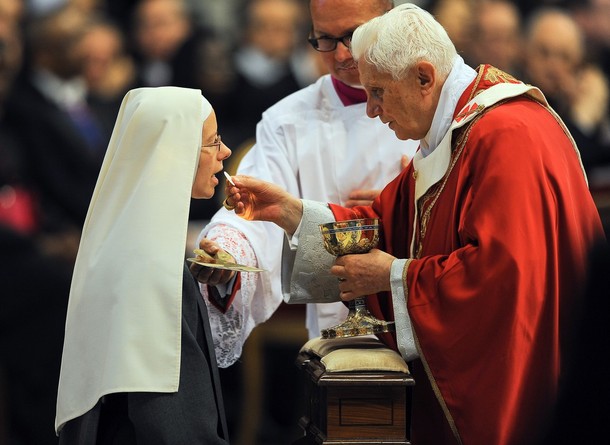
Interestingly, Pope Benedict XVI, in the latter years of his papacy, was seen to only distribute communion to those who received it kneeling and on the tongue. There are a number of pictures of this:


It is probably too much to hope, at the present time, that the old and venerable practice of receiving this way be restored. It would be a tremendous boon to the faithful, since treating the Eucharist as if it is actually Christ’s Body and Blood enhances our belief that this is true. When we act casually, as if it weren’t an important thing worthy of our reverence, is it any wonder to discover that so few Catholics believe it?
But more than for any other reason, we should do this out of love for our Divine Savior. For the sake of our own deference to Christ, we should not treat this sacrament as something which we are owed, which we get to take on our own terms. Stolen hosts are routinely desecrated by those who revile the Eucharist, and yet are easy to obtain when received in the hand. Particles are lost, containing His entire Body, Blood, Soul, and Divinity. Sometimes whole hosts are found in the pews or on the ground outside, only to be trampled underfoot.
The Blessed Sacrament deserves our greatest respect, and should be treated with the utmost care. If you are in the habit of receiving on the hand, out of love for our Eucharistic Lord I urge you to try instead to begin receiving on the tongue, according to the Church’s ancient practice. If you are able to do so without causing obstruction, also receive kneeling, as you would if you found yourself in the presence Christ the King. (Because, in fact, you are in His presence!)
It may seem unlikely if you are unfamiliar with the practice, but I guarantee it will have a positive impact on your faith.
I attend a NO at a local men’s religious shrine. It’s about as reverent and orthodox as can be expected. I certainly sympathize with your experience at your non – regular parish. Head down, eyes closed and praying fervently in gratitude and wonder that the King of Kings should come down from heaven to give himself to me. At other parishes, the irreverence at communion was beyond appalling and caused me a number of times, to offer reparation.
I want to recommend to all of your readers a particularly wonder book. “Real Presence” by St Peter Julian Eymard. The saint of the Eucharist. His writings on our eucharistinc Lord is a primer on adoration and why we should and how to do it. This is a book every Catholic cradle or otherwise should read, IMO.
We teach our youth about the real presence of Christ in the Eucharist – all happily receive kneeling and on their tongues. See http://www.fneexplorers.com/why-we-fne-choose-receive-communion-tongue for the story and photo’s.
I think it is also fitting to mention here the use of the “Eucharistic Ministers” who are effectively given the Priests privilege to distribute Our Lord to those in attendance. I believe this too furthers the lack of belief that Our Lord is present in the Host. I’ve observed anywhere from scantily clad young teens in miniskirts and halter tops to older men wearing tank tops, shorts and flip flops distributing Communion. All the while carrying on a conversation with the Altar boy(or girl) or singing and rocking side to side with the rock version of the Communion Hymn. All sense of the sacred is lost at that point. It’s no wonder that most Catholics today don’t even believe in the Real Presence. I once saw a picture on a blog of a young man in a Grover t-shirt distributing Communion. How would you like to see that the next time you go up to receive?
Boy do I ever agree Chris. We need to make much reparation to Our Lord for the flippant and casual attitude in which He is received. I have recounted now several times on the turning point for me of receiving in my hand where the Deacon snapped the host into the palm of my hand and it shattered. I quickly consumed it out of that hand and licked the palm of my hand profusely all the way back to my pew, trying to get every even invisible particle. Very upsetting at least for me. This was several years ago. And then two Sundays ago, going up to receive Our Lord, we were ‘treated’ to a rocking Protestant ‘Spiritual’ that was performed solo by one of our Choir members that has a liking for spirituals. I was wincing and cringing all the way as he was extremely LOUD over the microphone. It was almost unbearable. One of those that you hear and see that people are clapping and swaying. Lord HAVE MERCY ON US.
I, too, once was given the priest’s host that had been broken into pieces and had to lick my palm to consume the particles. It took a broken leg and using crutches to convince me that receiving on the tongue is the only way I will receive my Lord. The parish I attend also offers the bottom step for those who need to kneel as a sign of adoration.
There was a priest in the Diocese of Syracuse who persuaded his parish council to approve a restoration of the railing and made a practice of promoting kneeling and communion on the tongue (around the time the U.S. Catholic Conference insisted the norm should be receipt standing). After about a year and a half, he was summoned to the chancery and given a dressing down by Bishops Moynihan and Costello.
I wonder if I know this priest. I recall that there was one in Binghamton who did so under the auspices of a Lithuanian community with its own liturgical traditions. If you’re from the area, you no doubt know which priest I mean.
In fact, I wonder if we should know each other. I grew up in Binghamton. Was just there for a wedding this past weekend, in fact.
The priest in question is Binghamton born and bred, not Lithuanian but Irish. He was a curate in Binghamton from 1989 to 2001. It was during one of his subsequent postings he received this very personal reprimand, with scant doubt consequent to a letter of complaint from one recalcitrant parishioner.
The thing about receiving on the tongue is not that there is more reverence, but that the irreverence is not visible. Better to teach our parishioners that however they receive, it be done with reverence.
It’s absolutely more reverent. You kneel before a king. In fact, in an egalitarian society like Western Civilization has become, where nobody kneels before anyone, it’s an even deeper sign of respect.
And to receive on the tongue shows your submissiveness to Christ and the Church. You let them feed you. You ensure that no particle touches the ground. You do not grab or take what is before you, but you are given what is offered. Anthropologically speaking, there is such significance in the gesture…not sure how to make it clearer.
This book isn’t the place for the critique of recent liturgical changes in the Church-particularly the method of dispensing Holy Communion. But we’d like to suggest an experiment.
From now on, to get a movie ticket, Americans should have to kneel before a consecrated celibate wearing ceremonial robes and take the ticket between their teeth – never daring to touch it with their hands. Within a generation or so, they’d all develop certain ideas about movie tickets and their significance.
Now take the Eucharist and reverse the process, treating it like a movie ticket…Enough said.”
The Bad Catholics Guide to Good Living
John Zmirak
“There is a reason why the Church has long since determined that this method of receiving communion, though common in the early Church, is not advisable: because despite the best intentions of the most pious, as a common practice it leads to sacrilege.”
Where is the reference for this? Has the USCCB stated this? The Pope?
More than ever we need people in the pews to hear the Word of God. We should pray that they all feel God’s love and the love of the community. We should be there to support each other along our faith journey. I don’t think ‘worried looks’ from the priest or judgmental sighs from the congregational are going to make people feel welcome.
Jesus loves us all…the sinners, the tax collectors, and even those who receive communion in the hand.
Beth, yes, the Church has addressed this issue: receiving on the tongue while kneeling is not only every Catholic’s right, but also a devotion strongly advised by Holy Mother Church. http://ebougis.wordpress.com/2014/02/16/a-caveat-on-traditionalist-revanchism/
I quoted St. Thomas Aquinas. The disciplinary norm for well over a thousand years was that nobody was to receive on the hand. Even priests and popes receiving viaticum in the old days received on the tongue so as to avoid unnecessarily handling the host.
The earliest quote I’ve seen is from Pope St. Sixtus I, (pope from 115-125) “it is prohibited for the faithful to even touch the sacred vessels, or receive in the hand”.
You must understand that the practice of communion in the hand in the modern Church is a concession to disobedience which has now become commonplace. Certain Bishops in Europe were allowing their congregations to receive this way, and Pope Paul VI tried to contain the problem by giving them an indult.
Though the USCCB in unsurprisingly avoids discussing the preferred option for receiving communion (on the tongue) The Vatican Instruction Redemptionis Sacramentum says the following:
“[92.] Although each of the faithful always has the right to receive Holy Communion on the tongue, at his choice,[178] if any communicant should wish to receive the Sacrament in the hand, in areas where the Bishops’ Conference with the recognitio of the Apostolic See has given permission, the sacred host is to be administered to him or her. However, special care should be taken to ensure that the host is consumed by the communicant in the presence of the minister, so that no one goes away carrying the Eucharistic species in his hand. If there is a risk of profanation, then Holy Communion should not be given in the hand to the faithful.”
This itself is weak, but more forceful than the USCCB document on reception. Of course, as I said, the “recognitio” began as a very limited indult to contain an abusive practice which then spread. The majority of bishops around the world opposed changing the practice. You shouldn’t negotiate with liturgical terrorists.
Making people “feel loved” is, not to put too fine a point on it, far less important than showing love and respect to our Divine Savior. We are not in the business of worshiping our feelings, but rather of worshiping God.
If you’re going to come to Church and treat our Eucharistic Lord like movie theater popcorn, making you feel welcome is going to be a lot lower on my list of priorities than helping you to learn what is appropriate when approaching the sacrament.
I find this a good discussion of receiving Communion in the hand or on the tongue (note the apostolic origins of receiving in the hand):
http://www.vatican.va/news_services/liturgy/details/ns_lit_doc_20091117_comunione_en.html
I also like:
http://www.usccb.org/prayer-and-worship/the-mass/order-of-mass/liturgy-of-the-eucharist/the-reception-of-holy-communion-at-mass.cfm
There are many other excellent writings on this subject. Several of them emphasize the Eucharist and union with Christ which Steve’s post did not touched upon. Still, other articles speak of exercising charity towards fellow members of the Body of Christ as a prerequisite for receiving the Body of Christ in the Eucharist.
“He (or she) who has ears to hear, let him hear.” (Mark 4:9)
Beth, the people in the pews hear the Word of God at each Mass. If they are regular attendees, then they know that God loves them for it is proclaimed in both the written word and in the Mass itself, which is a representation of Christ’s sacrifice for us. I will be frank with you…you sound very Protestant. It is Protestants who, because they lack the sacrament of the Mass, have turned inward toward themselves and made their feelings about worship more importance than the actual act of worshiping the Lord. I can say this because I was a Protestant for most of my life. Additionally, it is not surprising that many Catholics feel the way you do, since the innovations in the Mass (like receiving in the hand) have so deadened their understanding.
“…have turned inward toward themselves and made their feelings about worship more important than the actual act of worshiping the Lord.” Those words about making it about themselves are so very true, unfortunately this encompasses most of the world, and is why we are in such a state. Everything is about “me”, very sad.
Yes, true. At least for the western world.
Beth, you said in part: “More than ever we need people in the pews to hear the Word of God. We should pray that they all feel God’s love”.
Ironically, Steve just gave you the unvarnished Word of God, and instructed you on precisely how a person may best dispose himself to feel God’s love. Regrettably, your inordinate focus on community and feelings has distracted you from hearing it.
What this ought to demonstrate to you is that your expectations for worship are wrong, and that they are in fact inhibiting you from actively participating in Holy Mass. Please understand, hearing the Word of God is not at all synonymous with feeling the love of God. Our Lord does not speak for the exclusive purpose of giving us warm fuzzies; to be sure, often times just the opposite is true. When a person really hears the Word of God (i.e. is convicted in his heart) he is likely to experience a marked sense of discomfort (and that’s putting it mildly) long before any subjective sense of emotional contentment.
When ABS lived in Cape Elizabeth, Maine, he had to oppose the local Pastor at St Bart’s who had his Catechists prepare the children to receive First Communion before First Confession and all of the children were taught to receive in the hand.
ABS took his children to First Confession before First Communion and he used Necco Wafers to learn his children to receive on the tongue.
So what if they were the only children in town to receive Communion properly?
The collapse of Discipline in the Catholic Church has strengthened the revolutionaries within the Catholic Church and it is a case of classic operant conditioning with the intermittent rewards for such things as Communion in the hand being the strongest form of conditioning; that is, revolutionaries are rewarded and their opponents punished.
On the other hand (pun intended) those who wish to worship as did their Fathers and Grandfathers are repeatedly rebuffed in their requests for a return to traditional praxis vis a vis the sacraments and they, understandably, begin to act like whipped dogs
but to identify those rebuffs as but the regard actions of the revolutionaries is labeled conspiratorial.
However, as Prof Mattei pointed-out in his great book, it only takes a small number of committed revolutionaries to create radical change.
Why do you think Communion in the Hand is so popular?
When one assists at the Mass, one receives Communion kneeling at a Communion Rail owing to the Sacrifice of the Mass and traditional pious praxis whereas when one assists at the new mass one is going to a meal and one eats a meal with their hands.
It is not complicated; the revolutionaries have almost completely triumphed; they have the vast majority of Churches and Communicants firmly in their control.
One must find refuge in a local Cave of Covadonga (FSSP, ICK, etc) and one must teach their children Tradition and Ecclesiastical traditions and prepare them for the LONG war to recapture the hierarchy; it took the Spanish over seven centuries to recapture their country – ABS sort of hopes we take less time.
The Cave of Covadonga may have already formed a Pelayo, an El Cid, an Alfonso, a Ferdinand, and they may have undertaken the long march through the Hierarchy; who knows?
But what can be known with absolute conviction is the battle has to be first identified as a battle before it can be joined.
Jesus loves us all…the sinners, the tax collectors, and even those who receive communion in the hand.
He also loved Judas, Pilate, Mao, Stalin, Hitler, and William Shatner…
I should know better than to type a response early in the morning before my brain is running full steam because I feel that my comments weren’t taken well. I never advocated for treating our Lord as movie theater popcorn. My point was that I think people can be reverent and understand the full meaning of Communion even when we receive it in the hand. I understand for some this is unacceptable and I totally support your decision.
I have known people who have left the Catholic church because they felt unwelcome or criticized and I just don’t see how that helps our Church grow. In fact around here they are flocking to the non-denominational Church down the street. And, no, I am not saying we should change Theology to reflect society. I am just saying when people are in the pews be happy they came. Don’t worry about if they said the right words, bowed at the right time, or took communion in the hand. We can lead and teach by our example. It is not only children who learn by example.
Yes, I think God loves us all. My husband is going to laugh and laugh when he hears I was compared to a Protestant! Don’t worry, I don’t take it as an insult. I have known many a good God fearing Protestant who I can only hope to have a faith as strong.
I also have known many God-fearing Protestants, and I’m glad you haven’t taken it as an insult as it certainly was not meant to be one. I merely pointed out that Protestants, lacking the Sacrifice of the Mass, often make worship services more about their feelings than about the actual act of worship.
Additionally, I cannot tell you how many times I have heard the comment, “I have known people who have left the Catholic Church because they felt unwelcome or criticized…”
This is almost a mantra in groups who are trying to “grow” their congregation. Look, in any group (religious or otherwise) people leave because they get offended or criticized, or whatever. This is the mindset of many today in our culture. A pity.
Catholics flock to the non-denominational group down the street because they’ve been given permission by the parish culture, the parish catechesis, and the neglect of a traditional liturgical expression of the faith. If one no longer believes in Transubstantiation, if one no longer feels the need for regular confession, if worshiping God is basically the same everywhere than why stay in the Catholic Church? It’s six of one, half dozen of the other.
How we worship affects what we believe.
Beth. You could have been married wearing scuba gear, standing on a skate board, and your husband could been wearing a Klingon Costume and he could have put the ring on your toe and you two could have had the best of internal intentions but those witnessing your marriage would not have been wrong to conclude from watching you that you two were not taking that sacrament seriously.
Why do you think Communion on the tongue was the norm?
Do your children take tests using lipstick; do you serve supper in a boot; do you put food on your children – wait, what ? Wasn’t that what George Bush said? – does your chewing gun loose its flavor on the bed…hang on, you’re making me crazy, Beth.
Stil, ABS does not believe you can’t understand the difference….
Steve,
Certainly reverence is important in the receiving of the Eucharist and in the Mass.
However, at some point I find myself looking at much of what is written here and observing that in many, if not most cases, that it appears to be advocating for form over substance.
Neither you nor I know, only God knows, what is in the heart of each person who shares in the Eucharist.
The arguments I see from many of the posts here advocate for the Old Mass over the New Mass. Again, it appears to be mainly advocating form. I submit to you that any person who is “properly disposed” will receive the full grace of the Eucharist whether they receive it on the hand or on the tongue. I also submit that any person who is “properly disposed” will receive the full grace of the Mass regardless of whether it is the New Mass or the Old Mass. Since this is the case, the most important part of the reception of the Eucharist and the attendance at Mass is coming with the “proper disposition” to receive the grace offered.
A person who kneels and receives the Eucharist on the tongue while attending the traditional Latin Mass may look good, but if they are not following the norms of the church in their conjugal relations or are driving a luxury car and living an opulent lifestyle while sharing nothing with their poorer neighbors, is it really more proper?
The Scribes and Pharisees looked great at all the temple functions and to their society. They prescribed all of the proper rituals and procedures, but what was in their heart? One must be careful not to become overly obsessed with form over substance. Not as man sees, does God see.
Peace in Christ,
Tim
Let’s say music is a substance. Mozart is a form, and Justin Bieber is a form. Is one superior to the other, on an objective level?
Let’s say a funeral is a substance. A black suit and tie to attend is a form, and a Hawaiian shirt and shorts is a form. Is one superior to the other, on an objective level?
You see, in most situations, we have no problem recognizing the propriety is something objective. That there is, within the natural order, a hierarchy of goods. Something we prefer. We see this in the circumstances we’ve mentioned. We feel this viscerally when our kids misbehave in a sacred space. We tell them, “This is not how you are supposed to behave.” How do we know? Because some truths are self-evident.
Nobody is making an argument about whether or not a man is in sin when he receives the Eucharist a certain way. We are only making the argument that receiving the Eucharist a certain way is more proper than other ways. A priest can confect, receive, and distribute the Eucharist in a state of mortal sin. It does not affect the validity. We call this ex opere operato.
A man who receives the Eucharist reverently, even if he secretly goes home to his mistress, doesn’t give scandal to others, and at least has the good sense to show deference to God.
The state of his soul is his own affair.
An excellent example Steve. I lived in Hawaii for four years. I considered wearing a tie to a wedding. I checked first. Hawaiian shirt was expected! I didn’t experience the necessity of attending a funeral there, but from my understanding, a suit would be out of place.
And so it is with your article here. First off, you are an excellent communicator. No flattery, you write well. But your approach and in quite a few cases your logic is flawed. I remember well a book called “How To Think Straight” in high school. An excellent and easy book on logic.
But let’s get back to the point. If you went to the funeral of a friend who liked the Grateful Dead, what type of music might be played? You are advocating for a one size fits all when you use the word “should.” Only God himself or the rightful authorities of the church can realistically use should. The rest of us can say “I think it would be better to…” or “I would prefer” or you can say “You could receive Holy Communion on the tongue” and then describe the reverence it gives and other benefits. Should implies judgment on those who do not follow your way. For an excellent example, you can read many books on this subject, one of which is “Perfecting Ourselves to Death” .
Since you are an excellent writer and you are also a learned person, you also know that you could write your articles in a much more even keel. You also know that when people make derogatory comments about former and current Popes that you could set them straight.
Derogatory and cynical comments often reflect anger that has been repressed and is now spilling over. Anyone who has been to a 12 Step meeting and begun to examine themselves more closely in a spiritual light eventually finds that it is their own defects of character that are causing their unhappiness. I am not saying that you are fomenting anger, but I am saying that you are stirring the pot and that as a Catholic and a Christian you have an unspoken obligation to keep your writings tactful, respectful, and not dictatorial.
One comment I would make about the disparaging of the current Pope (and earlier popes by others here) is that even David who it would appear would have been totally within his rights to slay Saul, did not do so. He said that he could not harm God’s chosen king.
I cringe when I hear people disparaging Pope Francis. You know, God was not sleeping when Pope Francis was chosen. What God has allowed and has been ordained by the successors of Peter is valid whether you or anyone else cares to admit it or not. Some of the kings of Israel were standout men of God, others not so, but they were the successors who God allowed to rule. Our pope is the successor of Peter. When people harm the reputation and discredit the reputation of the pope, are they not harming God’s chosen one? Is the righteous excuse to cast dispersions on whether the current pope is a rightful or suitable successor to the chair of Peter as is often being done here?
The whole rosary thing was blown out of proportion. Someone who ponders the issue quickly sees that the Pope was trying to tell them to “pray” the Rosary and not just “say” the Rosary in large numbers to impress him. When we say the Rosary, it helps our state of mind in that it displaces less wholesome thoughts with the grace of Mary. When we pray the Rosary we engage our mind as well to enter in to the mysteries of Christ her son and can more fully enter into and pray for the whole mystical body of Christ. (i.e. vocal prayer vs. mental prayer)
My friend, are you being fair and balanced in your treatment of the New Mass, communion on the hand, and the current Pope? Can you not find any good things to say about them without it being a backhanded compliment or a total disavowment?
I have written this here rather than post to each individual comment. Perhaps someone could have told Jesus that it was bad form to hand the broken bread to his disciples. You know, he could have went around and put it on their tongues? He had not yet breathed upon them and told them to receive the Holy Spirit. Were they officially ordained yet?
I really think that anyone who wants to receive communion on the tongue can. Some might say that genuflecting or going down on one’s knees is even better. (This is not good for me…when I was knighted by the K of C, my bad knee gave out and I fell on my knees rather than knelt ) But I believe it matters little since it is the disposition of the receiver which matters more. But even this is subordinate to the Will of God as you showed by the story of the unruly knight in your article. It is Christ who can and does effect the change in a person according to His Holy Presence and Will. Receiving the Eucharist on the hand or on the tongue will not change this… Rather it is the reception of the Eucharist itself that is life changing!!!
Reconsider the tone and content of your writing. I don’t ask you to drop your passion in writing; I find some very interesting articles here. Are you treating the people who you criticize with love and respect?
Specifically to the issue of communion on the hand, I would add this:
When I go to communion, I’m not watching what other people are doing. I am preparing myself in prayer for my Lord. When I come back from communion, I am in prayer. Quite a while back, I had caught myself watching what others were doing. I feel the God spoke to me about it later during Eucharistic Adoration that I was to keep my mind on Him! – (As you stated above – the state of one’s soul is their own affair). Is it not a blessing and a sign of growth in prayer to learn to pray through the distractions?
Yes I respect your call for reverence! No horseplay! No walking away with the host. But even in the “old days” there was horseplay. As an altar boy, I knew those who playfully bumped the Adam’s Apple of the recipient with the paten. There were people even then who went back to their place holding the Eucharist in the corner of their mouth or who left Mass with the Eucharist in their mouth not treating the Body and Blood with due reverence.
I pray for the many times that the Body and the Blood of Christ has once again been abused and disrespected. One of my dear friends who is advanced in years and whose son is a priest often is near tears when he sees how little our adoration chapel is used. He ponders the great loneliness Christ must feel at once again being alone and deserted by those he loves.
Steve, please do all that you can to show proper respect to persons and to build up and not tear down God’s chosen ones and be kind even to those who you are tempted to hold in contempt!
As far as I know, we don’t get any extra points for doing every thing “right”. When I watched the story of Mother Teresa on EWTN, one of the quotes I remember (not necessarily hers) is that in the end we will be judged on how much we loved.
Peace in Christ,
Tim
I see your point, Tim the outward appearances thing.
I can’t generalize for the EF as my experience there has been confined to a single community. But, I have never seen other outward signs of lack of reverence like back slapping and chatting in communion line, plopping down in the pew half way thru the first reading, unchaste clothing and talking in the pews at the outset of the Mass. All of those I routinely observe a OF Mass thru out my diocese. Communion in the hand again. Maybe this isn’t true in other diocese but I would guess (if I may) that this is not unusual.
I really do believe “the law of prayer is the law of belief”. The inward cannot help but follow the outward appearance. Sorry. I don’t want to “judge” anyone but it’s hard for me to think logically all these outward signs of irreverence are not an indicator of interior lack, too.
Lets not forget, the outward signs of irreverence are upsetting to the reverent. Those who wish to be reverent are distracted and upset by irreverence, and therefore prevented from maintaining a state of reverence without an act of extraordinary interior will, which in itself creates an additional barrier. thus on two levels reverence becomes impossible. I have to believe this was by design.
Hello Keith,
I am struggling with this issue of sorts even as we write. The adoration chapel where I go for exposition and prayer has a lady who brings a baby and a young daughter. The daughter whispers and squirms and it distracts me. I pray about this…
What is the thing to do?
1. Go mention it to the priest.
2. Say something to the lady.
3. Pray through it
4. Come at a different time.
Whenever I pray about this, the only answer I get is a smile of sorts from God (Jesus). Every once in a while I get the feeling that he smiles and starts to hand me a thorn from his head. My friend, it is beyond me…
I know that he is telling me to respond with love.
! am still praying (smiling)…
There is no perfect world, there is no perfect situation…only life…which is messy and sometimes disappointing and imperfect.
What am I to do?
Once again, I am still praying…
Peace in Christ,
Tim
P.S. A friend who I invited to come with me to the chapel smiled and said that he enjoyed it because he saw the little girl growing up to love coming to the chapel through the time spent their with her mother and Jesus.
“I submit to you that any person who is “properly disposed” will receive the full grace of the Eucharist whether they receive it on the hand or on the tongue. I also submit that any person who is “properly disposed” will receive the full grace of the Mass regardless of whether it is the New Mass or the Old Mass.”
And no one here, least of all Steve, I think, has argued otherwise. Rather, the points are 1. How it is received in general will affect what many people perceive is going on, and thus whether or not they are “properly disposed.” And 2. It’s not merely about how much grace you receive, but, well, the proper way to receive such grace. You just owe God a certain amount of reverence, whatever you “get” out of eating His flesh, and however forgiving He may in the end be about your lack of reverence. There’s an intrinsic value in giving reverence where reverence is due, as it were, whatever else may or may not follow from it.
REALLY well expressed Oakes.
So, the idea here is that everyone appear reverent, at least to the casual observer…
I agree with you that reverence is indeed important. However, forced behavior more often results in what is known as “compliance.”
True “reverence” will only come about through education from the pulpit of the church and a good example set by the priests, alter servers, members of the parish council, lay staff and other positions of responsibility. It’s a good place to start.
I am afraid it is going to have to be restored and promptly. It has recently been discovered that the practice of Communion in the hand is a liturgical abuse that started in Holland. Pope Paul VI wrote a letter on this and it stated that the preferred way for the Faithful is Kneeling and on the Tongue at ALL Masses Latin and New Order alike. The practice was not favored by the Council Fathers most Bishops or even Pope Paul Himself. He said that Bishop’s Conferences were to NOT allow it where it was already not a practice which means the US. But that came to an end in 1977 June when Cardinal Bernadin managed to deceive the Pope that it was being done here. For more info check out Church Militant TV show Sleight of Hand where he discusses this insidious practice.
Wonder how long it’ll be till Bernardin is on the fast track to canonization under this pontificate?
Look, without trying to be blasphemous or offend anyone, ceteris paribus the Doctrine of the Real Presence is unbelievable, bizarre and even potentially offensive to many non-Catholic Christians or theists. Let’s admit it. On it’s face it’s pretty freaky. You’re eating THE ACTUAL FLESH of this guy (who was at the same time God) who lived 2,000 years ago. And this is true because some other guy wearing a ceremonial robe has mumbled a few words over a wafer. The atheist Bill Maher, I think, has called attention to the fact that most non-Catholics don’t realize how downright weird official Catholic teaching is on the matter. Every Sunday we proudly eat the space god (as Maher puts it). But like many atheists, as opposed to liberal or mushy Christians, I think Maher gets it at least partially right. In truth, the sad fact is that many, if not most, CATHOLICS do not these days realize how “weird” it is. It’s a great thing but it’s also a weird thing. We do “eat the space god”. But since that is unreasonable on its face we need to be sufficiently catechized to actually believe it. Most Catholics these days are not sufficiently catechized. And the manner in which Communion is generally received (in the hand from some layman wearing a “Grover” t-shirt or whatever) reinforces that ignorance.
The only thing I can really add to that is to walk it out two more steps….the reason most people have not been sufficiently catechized is that the teaching of the Teaching was “unofficially” changed; and the reason for that is that MANY (if not sadly most) prelates have lost their belief in it. Period. End of story.
This is one of the best analyses on the point I’ve yet read. (***not for the fainthearted or easily bruised)…..
http://www.barnhardt.biz/2014/05/07/the-cool-kids-dont-actually-believe-any-of-that-bullshit/
And her points #4 & #5 on the following are also dead-on, in her inimitable blunt style (this whole post is actually well worth the read….
http://www.barnhardt.biz/2014/06/18/tomato-soup/
I never receive unless kneeling and on the tongue. In January my wife and I had the privilege of attending Mass in Saint Peter’s Bascilica. The priest offering Mass was a Cardinal whose name escapes me. The Mass was in the ordinary form, in Italian, a language I don’t understand.
When it came time to receive Holy Communion, there was a rush of people heading to the front, queueing up only in the last few feet before the Cardinal. There was a policeman standing next to the Cardinal for his security.
As you might imagine, everyone was receiving in the hand while standing.
When it came my turn, I dropped to my knees and extended my tongue. The policeman reached down to grab me by the arm and lift me up. By the time he did that the Cardinal had already given me Communion so I got up on my own.
The policeman wasn’t trying to help me up out of kindness. I’m not an old man and am clearly in good health. I was dressed in coat and tie.
So in 2014, in Saint Peter’s Bascilica in the heart of Vatican City of all places, if you dare to try to receive Holy Communion on the tongue while kneeling, you may be considered a hooligan by the gendarmerie.
To the Cardinal’s credit, he didn’t hesitate to give me Communion after I knelt.
Rejoice. Since you are a disciple of Christ, you can count being considered a hooligan as a badge of honor to suffer the scorn of others for the name of Christ. It is not the approval of others that one must live for.
Thank you, Tim. My point, which I perhaps didn’t make well enough, was not so much that I was considered a hooligan for kneeling down to receive the Blessed Sacrament. That matters not at all and I do appreciate and agree with your take on that.
My point was that it was to me both alarming and sad that I was considered so in St. Peter’s Bascilica.
Holy Communion MUST be received on the tongue. Many times when I go the Mass on Monday morning, there are small pieces of the of the Eucharist on the floor of the Church. When I brought this up with the Pastor he practically just shrugged his shoulders and said something about how the EM’s have to be more careful. Shameful!
Btw – Joey Lomangino died – the man the “seers” at Garabandal said who receive new eyes when the “Miracle” occurred. Another false apparition bites the dust.
typo — said would receive new eyes when the “Miracle” occureed.
You’re eating THE ACTUAL FLESH of this guy (who was at the same time God) who lived 2,000 years ago.
He is still alive and in Holy Communion one receives the Body of the Risen Christ * but what in the world are you doing adopting the categories of that nut?
Space God..bizarre..weird
None of that is accurate. Mystery, yes ; but the hateful blathering of Bill is bogus.
Holy Communion is not bizarre or weird and one of the mistakes we Christian Catholics make is to adopt the language of those who hate Jesus and His Church.
Let the Messias-Deniers learn to speak of God reverently or tell then to go to Hell.
ABS sure as hell would not tolerate another man calling his wife a broad….
* The Risen Christ has passed over into the Sacraments (Pope Saint Leo the Great. as I recall)
“He celebrates the traditional Mass whenever possible, but as a diocesan priest, he is obligated to celebrate both forms.”
Why is that the case?
Can’t a diocesan priest inform his bishop that, in accordance with the norms of Summorum Pontificum, he has decided to offer Mass from now on using only the old missal?
Why can’t a priest do that?
DJR
Because bishops don’t allow it. They say, “I need you to do the masses at X parish, we don’t have enough priests” or “Summorum Pontificum was never meant to preclude the ordinary form” or whatever other excuse seems convenient.
They don’t understand what it does to a priest to learn and love the old mass and then be forced to say the new. And frankly, they don’t care.
Steve,
As far as I know every priest still takes a vow of obedience.
Adam and Eve’s first sin was disobedience. Obedience is often difficult. Failure to be obedient is usually the first sign of trouble in the life of a priest. Jesus came not to do his own will but to be obedient to the will of the Father. Disobedience of any type is a slippery slope. Again, obedience is not always pleasant, but is done in a spirit of love. I often read the writings of Mother Teresa because she so carefully lays out the need for obedience.
I know that many will come up with exceptions to this by “what ifs”, must you still obey? I listen to them all the time. But Mother Teresa specifically reminded priests and her sisters in the community to obey the pope and to obey their superiors.
I am going to follow her example, not the example of someone who says they have good reasons to do what they want to do.
It is perfectly fine, however, for a given priest to refuse to offer the Traditional Mass and offer only the NO. There was a parish in the New Orleans Archdiocese (St. Benilde) that used to offer a weekly Sunday TLM. They got a new pastor (man in his 30’s) and he discontinued the TLM altogether.
When I asked one of the ladies who work for the parish what reasons did he give for discontinuing it, she told me that he said he was discontinuing it because 1) he didn’t know Latin, and 2) the mass usually brought in a lot of people from outside the parish so he didn’t feel the obligation to continue it for them.
That was the best he could come up with.
Jason, if you look at it from his standpoint, it makes sense. Is he to spend his time learning Latin to please people who are not happy with the Mass at their parish? If he has a pastor’s heart he will be tending to the needs of his flock. Now that flock can include people from another church, but there is no obligation for him to take on the responsibility of offering a particular Mass.
There are people who flock to other parishes in my area because they provide confessions on a more frequent basis, exposition of the Blessed Sacrament and one on one pastoral help for those in need regardless of their parish. They are truly pastors.
If all that was offered in my area was the Latin Mass, I would attend, but whenever possible I would go to one in English. As Scott Hahn says: Jesus Christ is present in all the glory of the Second Coming in the Eucharist. I’m there for the amazing presence and reception of Christ! Anything else is icing on the cake.
All excellent points, good people. One has yet to be offered and so if your patience would allow me. black masses. Voltaire was once asked by a good Catholic teen how she might lose her natural modesty and join in on the filth he was proposing. He said, “I know very well. Sin mortally, something you know very well is thus. Then, go to communion as soon as possible for there is no surer way to turn a man into a devil than to receive sacrilegiously..” The satanists are better catechized on the Doctrine of THE REAL PRESENCE then our own people. The occultists, on this, their summer solstice, will commit the greatest atrocities to animals, flesh, souls, and the greatest crime against God, indignities directed at THE MOST BLESSED SACRAMENT, an homage to the dark horrors of Holy Thursday/Early Good Friday Morning when OUR LORD was treated with the greatest contempt, blasphemy, and sacrilege. All of this to honor creation’s greatest wretch. Again, I will cringe, Sunday, when I see every manner of lay people approach the tabernacle, pyx in hand, to ostensibly deliver THE SACRED SPECIES, to some home-bound soul. I wonder. Our lispy organist goes to the tabernacle, after the Mass, with a chatty, suddenly bouncy priest, they pause their jolliness, quickly genuflect, open the Tabernacle, communion is given in the hand, the organist pops it back irreverently, the Tabernacle is closed, a quick genuflect, and the merriment continues. Every Sunday it’s all I can do not to shout “MERCY!!!”, and not just utter it softly, while continuing my Thanksgiving. The satanists don’t care about the bread that is “communion” for heretics, neither Jew, nor mohammedan pieties have any meaning for them either. No, they want to kill God again, but just not God, but God at his most vulnerable, most humble, most loving. When priests have had visions, upon the elevation following the consecration, and others who have had the privilege of seeing, always report seeing THE DIVINE INFANT (where there have been Eucharistic Miracles, The SACRED FLESH is always found to be THE HEART MUSCLE, and the SACRED BLOOD, always “ab”.). So this is not the Apocalyptic drama of the grand mistake meeting The KING OF GLORY mounted on a White Stallion, no, this is much darker, This is an attack on THE DIVINE INFANT. It’s what they do, who they are, and how they pay for being given the kingdoms of this world. What can we do? Model reverence, use means, prayers of reparation, and appeal to the maternal and paternal in every soul to imagine the satanists coming to slaughter The Holy Innocence again, but this time the DIVINE INFANT is among them, and they know it. What of us, even the least, would not summon a fiery anger, if so much as a daycare was threatened by some depravity? The danger is far greater here! This time, though, this spiritual Bethlehem can be spared Rachel’s despondency, if we only reverence, protect, and show hell a holy hatred that mimic’s Michael’s outrage in Heaven! (So say your St. Michael Prayer during “The Prayer of The Faithful”, and again, after Mass, during your Thanksgiving as well.) For THE WORD WAS MADE FLESH..to destroy the works of the devil! Let’s use our hands to defend not diminish THE LORD!
Tantum ergo Sacramentum
Veneremur cernui:
Et antiquum documentum
Novo cedat ritui:
Praestet fides supplementum
Sensuum defectui.
Genitori, Genitoque
Laus et iubilatio,
Salus, honor, virtus quoque
Sit et benedictio:
Procedenti ab utroque
Compar sit laudatio.
Amen.
One of the best I have read on this subject, along with your responding comments. Thanks Steve. Yes, I too am heartbroken by the disregard and profanation I see at Communion. How can there possibly be adequate reparation?
Why can’t people simply receiving kneeling and on the tongue? Its not hard. Just do it. Makes me wonder if there is a diabolical element to this stubbornness.
The abuse is not just ‘Communion in the Hand”, more specifically this should be called “Communion in any unconsecrated hand” such as laymen handing out the Eucharist and handling sacred vessels.
I teach at a K-8 Catholic school. Checked my school email today and found this from the Principal:
” …regarding Catholic staff being trained as Eucharistic ministers. I would love for every Catholic staff member to serve as a Eucharistic minister as I believe the children love to receive communion from teacher and staff members. Will you please consider doing this if you have not already? Thanks!!”
This is the second year the thumbscrews have been applied. I’ve ignored the “please consider doing this” so far but wonder how long I’ll be able to get away with it because the administrator is not particularly reasonable. Thanks for the Aquinas quote; it might come in handy because this is a hill I’m willing to die on.
Worst Eucharistic minister moments (and I go to a pretty reverent church): Minister spilled the Precious Blood and continued to do her thing in front of the puddle. Minister decides the best thing to wear that day is a snakeskin print wrap dress. Minister/angry administrator at school mass snaps the host into my hand.
Gracie,
I think that only an army of priests whose celibacy has been closely monitored since ordination should offer you Holy Communion. I think you should wear coveralls as well to protect yourself from nasty spills such as you describe or inadvertent contact with your sinful cohorts as the sin might rub off and stick to you until your next daily Confession.
In a recent debate with a former friend over this impiety at Holy Mass I encountered a very serious issue on exactly the matter of Communion. I was confronted with the argument that since the priest, himself, stands and commingles both species on the altar after consecration, then there is nothing sinful about doing the same in one’s mouth while standing. I quickly retorted words that could have only been divinely inspired. I said, “Do you eat that way?” Do you stand up and publicly stuff in a fist full of M&M’s while you already have a mouthful of Skittles?” Although this did not change his mind, it did seem to make him think. In fact, he got up and left. Getting a person of faith to think is a great accomplishment in my book.
I feel I must add one more thing. We must not, in discussing this matter, confuse illicit Public Oral Commingle or Asynchronous Tongue Intinction with the form of these acts made licit by valid petition to the local ordinary’s faculty to dispense with the demands of Canon Law regardless of posture. For a licit and properly sanctioned POC or ATI is in no way to be understood as contrary to Catholic orthodoxy and orthopraxy. As long as it is sanctioned you may even hop while doing it. Does not the scriptures say “we will meet the Lord in the air?” It is the illicit form of these, despite resembling exactly the licit form of these, which rightfully draws our righteous and utterly justified rebuke and condemnation.
Yes. The pope, himself, might agree that the mouth must be clear and that some part of the body should be touching the floor. Otherwise, the same thing will touch the same thing and become one, big thing of sameness whether up or down. I think this is the biggest problem facing the Church today. Too many people are refusing, sinfully I might add, to swallow on time and while kneeling. In some sense, this is a theological nightmare if you think about it too long. Christ wants those things separate until they are well past the epiglottis. Let them touch and who knows what might happen. I for one do not wish to find out.
Come to think of it, if you read the Synoptic Gospels closely, you’ll see that Judas was in a big hurry at the last supper. He stood up from the table. No doubt, he also committed an illicit erect Public Oral Commingle or Asynchronous Tongue Intinction, if you prefer. I use both terms as I think something this terrible requires great description. When we think of Judas, we tend to only focus on his betrayal of the Lord. But I think this standing while chewing was even worse.
That being said. For wedding couples, kneeling for reception is a good idea at their weddings and later that night as well.
Thank you for bringing this atrocity of sinful mouths swallowing the Eucharist while standing erect to the attention of many who were worrying about it. I hope the Pope does something about this blatant epidemic of impiety.
In the Diaconate class my husband attended, Mass was celebrated before classes began. One man in the class received Communion together with his wife who also attended class. They knelt and received on the tongue.
The man was dismissed from the program because his kneeling and receiving habit “drew attentiont to himself.”
I guess he was perceived as trying to be more reverent than the other men.
Really… may the Lord have mercy on those who elected to have him removed from the class just because he was following the norms of the church, the preferred method of receiving our Lord as instituted by Pope Benedict at any Masses where he served Holy Communion. If we truly believe that this little host is truly the living body, blood soul and divinity of Jesus, Our Lord and Creator… and one has the “pride” to stand in front of our Lord – really???